| |
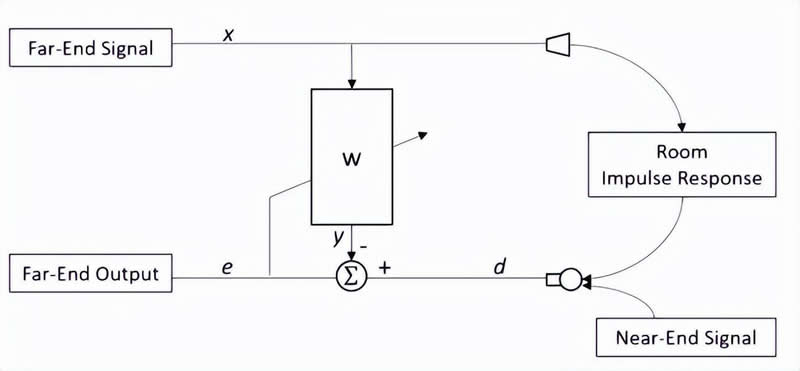
Echo cancellation is used in full-duplex communication systems to suppress acoustic echo and line echo. Its basic principle is to establish an acoustic path model between the far-end signal and the local microphone, and use an adaptive filtering algorithm to estimate the echo component in real time for cancellation. The algorithm first extracts the far-end playback signal as a reference and performs time alignment with the mixed signal collected by the microphone to eliminate delay deviations caused by transmission and hardware. Then, it uses the NLMS adaptive filter to fit the echo path, generates a predicted echo signal, and subtracts it from the collected signal to achieve linear echo cancellation. At the same time, double-talk detection identifies the near-end speech state to prevent filter update anomalies that could lead to voice distortion. For residual echo that is not completely canceled, non-linear processing (NLP) and comfort noise generation are used for further suppression, avoiding abruptness during silent segments.
|
|